
Contract X-38 and what came after it
Canadian sources onlyRemove the overseas campaigns, the foreign inquiries and the files at Kew. Keep only what Canadian institutions did, funded, published and declined to examine. This is what is left standing.
Canada built the science of sensory deprivation as an interrogation method — on its own citizens, with its own defence money, across two universities and twenty-three years — and never held an inquiry into it.
Every element below is documented from Canadian sources: Defence Research Board contracts, McGill and the University of Manitoba, RCAF personnel as subjects, a Winnipeg newspaper, a Quebec class action, and a current Department of National Defence manual.
Montreal builds the method
1951 – 1955 · McGill University- 1 June 1951 · Ritz-Carlton, MontrealThe Defence Research Board convenes a closed meeting on brainwashing. Canadian and British defence officials attend, with two CIA officers. Canada calls the meeting.
- Contract X-38A secret DRB contract to D. O. Hebb, McGill — “Experimental Studies in Change of Attitude.” Roughly $10,000 to begin.
- The apparatusPaid student volunteers in a cubicle: translucent goggles over the eyes, tubes over the arms, the constant hum of a fan. Not darkness — unvarying input.
- The findingHallucinations, delusions, impaired cognition, and a measurable rise in susceptibility to persuasion.
- Published in the openBexton, Heron & Scott, “Effects of decreased variation in the sensory environment,” Canadian Journal of Psychology, 1954.
- CirculatedCopies of the research went to all three branches of the US military and to the CIA.
Inside the cubicle · McGill, contract X-38
Nothing is taken away. Everything is held constant — which is the part that does the damage.
Weyburn asks the same question
1951 – 1954 · Saskatchewan Hospital, Weyburn- 1951 · Weyburn, SaskatchewanThe year Hebb takes contract X-38, two young British psychiatrists, Humphry Osmond and John Smythies, join the staff of the provincial mental hospital at Weyburn. Abram Hoffer is already building Saskatchewan's psychiatric research programme for the Department of Public Health.
- The questionThe one McGill was paid to answer: what makes a sound mind see things that are not there?
- April 1952 · their answerChemistry. In the Journal of Mental Science, Osmond and Smythies propose that schizophrenia comes from the body's own adrenaline going wrong, producing a mescaline-like compound they call “M-substance.”
- 1954 · the candidateHoffer, Osmond and Smythies report that adrenochrome, the red oxidation product of adrenaline, has hallucinogenic properties. They tested it on themselves.
- Who paidThe Rockefeller Foundation, about half a million dollars over six years, with the Saskatchewan treasury and federal health grants. No defence contract appears in the record.
Same question, two answers · 1951 – 1954
Same country, the same three years, the same question. The answer that needed no drug went to the CIA and became a method. The answer that needed a molecule went to the writers and became a myth.
A Canadian runs Nairobi's police
1951 – 1955 · Kenya Colony
This branch describes torture, sexual violence and the killing of prisoners as the record describes them. What was done in Kenya comes from Kenyan and British records. What Canada did comes from Canadian ones. The pictures are illustrations: they carry no evidence, and every finding rests on the documents cited.
- The manJohn Timmerman, born 13 March 1911. RCMP, 1932 to 1940. Canadian Intelligence Corps through the Second World War, then criminal investigation for the Allied occupation of West Germany.
 Illustration18 February 1951 · NairobiAppointed Assistant Commissioner of the Kenya Police. He takes over the colony's Criminal Investigation Department, brought in to reorganise it. The Kenya Gazette publishes the appointment on 6 March.
- October 1952The colony declares a State of Emergency against the Kenya Land and Freedom Army, the movement the British call Mau Mau. Timmerman's CID is the department that questions suspects.
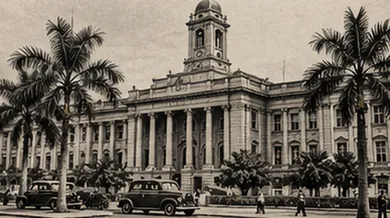 Illustration1953The Illustrated London News prints him “of the C.I.D., questioning Mr. Ferguson's Kikuyu cook” after a settler murder. By the end of the year he commands the Nairobi police: “the new broom at the head of Nairobi's police,” in the words of Time and Tide.
 Illustration24 April 1954 · Operation AnvilThe army and police seal Nairobi and screen the city block by block. Tens of thousands of Kikuyu, Embu and Meru men are taken to the camps. East Africa and Rhodesia: “Timmerman, Assistant Commissioner of Police, was in charge of the police.”
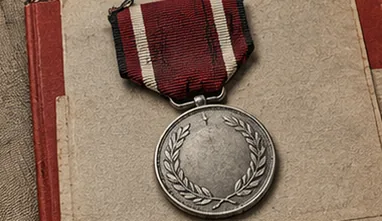 Illustration10 June 1954 · six weeks laterThe London Gazette lists him among the Birthday Honours: the Queen's Police Medal for Distinguished Service. A later Gazette mentions him for “distinguished services in Kenya” from April 1954 to October 1955.
- His own wordsA defence lawyer at the Kenyatta trial, Dudley Thompson, remembers “a giant of a man” who “had once been a member of the Canadian Mounted Police,” and quotes him:
We are not going to sit and talk with murderers, cattle thieves and barbarians.
Exhibit · what his department was doing
- The Kenyan historianBethwell Allan Ogot, Kenya's senior historian of the period, in his essay “Mau Mau and the Fourth Estate”:
Beatings of suspects to obtain evidence was rampant especially in Nairobi where Mr. John Timmerman, the notorious C.I.D. Chief (the Himmler of Kenya as he was called) and his henchman G. Heine presided over the torture chambers.
- The henchmanGerald Heine, Superintendent, CID Nairobi. Thompson calls him “particularly evil.” When Kenya's independence came he moved to the South African Police, 1963 to 1965.
- The methodCaroline Elkins, from the colony's own files and from survivors, in Imperial Reckoning. The CID, “according to one member of the force,” were “effectively the colony's Gestapo.” Men were held upside down with their heads in a bucket of water while sand was forced into the rectum. Men were raped with knives, bottles, snakes and scorpions. Women were gang-raped. Women's breasts were mutilated with pliers.
- The men who did it, in their wordsA former settler in the Kenya Regiment, to Elkins:
We would go and pick up a few of the filthy pigs and bring them to one of the interrogation centers set up by the CID. These were the hard-core scum, the ones who wouldn't listen to anyone and [were] causing trouble. So we would give them a good thrashing. It would be a bloody awful mess by the time we were done. … never knew that a Kuke had so many brains until we cracked open a few heads.
- The CID head who tried to stop itIn March 1954 London sends Colonel Arthur Young to command the Kenya Police. He puts Duncan MacPherson in charge of the CID to investigate the camps. MacPherson's letters, read into the House of Commons by Barbara Castle on 16 June 1959: he investigated “311 deaths … as a result of violence”, and witnesses against the Home Guard “were whisked away on a detention order.”
I was told by the Commissioner of Police … to stop investigations into such things. I refused and that was the main reason I left Kenya.
Young resigned before the year was out. His report was suppressed. Timmerman's medal and his move to Ottawa fall inside the same window. - The campsMost of 1.5 million Kikuyu were confined in detention camps or in fortified villages behind wire. More than 1,000 men were hanged. The official count of insurgents killed is about 11,000; the demographer John Blacker puts the excess deaths at around 50,000, more than half of them children under ten. Thirty-two European settler civilians were killed in the whole Emergency.
- 3 March 1959 · HolaGuards at Hola camp beat eleven detainees to death for refusing to work. The colony first said they had died from drinking contaminated water.
- The survivorsIn London's High Court, Kenyans who survived the camps sued the British government. Paulo Nzili was castrated. Wambugu wa Nyingi was beaten unconscious at Hola and survived. Jane Muthoni Mara was sexually assaulted with a heated bottle. On 6 June 2013 Britain settled with 5,228 survivors for £19.9 million. The Foreign Secretary told the Commons Britain “sincerely regrets” the abuse. That is not an apology.
The same years, two rooms · 1951 – 1955
Nothing in the record shows Hebb's science reaching Nairobi, and this page does not claim it. The Parker report of 1972 lists the theatres where Britain's interrogation techniques “played an important part”: “Palestine, Malaya, Kenya and Cyprus.” Canada built the science on one side of that list and lent a policeman to the other.
Exhibit · what Ottawa did with him
 IllustrationJuly 1954 · home on leave“Foremost Battler against Mau Maus Visiting Ottawa,” the Ottawa Journal, 24 July. Two days later the Ottawa Citizen: “Fights Mau Mau: Terror Shadows His Kenya Beat.” In August he gives the RCMP an album of his Kenya photographs.
 Illustration20 January 1955 · the SenateSenator F. W. Gershaw, back from Nairobi, tells the Senate he toured a camp holding “1,500 Mau Maus”, “savage in action and appearance, and certainly savage in thought.” He quotes a magistrate:
We cannot convict these people, because we are unable to get evidence against them; those 1,500 detainees will never come to trial.
He offers the North-West Mounted Police as the model for “control … over those savage and warlike people.” Nothing follows. Illustration16 December 1955 · External AffairsTimmerman joins the Department. The position is head of the Department's security programme. Its official history:
John Timmerman, who had served in the Canadian Intelligence Corps during the Second World War, and more recently as senior assistant commissioner of police in Kenya, was chosen for the position.
The Kenya rank is the qualification.- 7 February 1956 · the HouseLester Pearson's only statement on the Mau Mau in the Commons. Asked whether Canadian ammunition could reach them, he answers:
So far this ammunition has only gotten into the hands of hon. gentlemen opposite, where it is being used not with an effect that I would describe as lethal but rather as a soporific.
- 1959 · the year of HolaThe word Hola never appears in Canada's Parliament. CBC's Front Page Challenge puts Timmerman on national television as its Mau Mau story.
- 1959 – 1962John Starnes, later Director General of the RCMP Security Service, on his security caseload: “Dealing with personnel problems was made much easier by having John Timmerman to assist me,” and “he could be tough when it was required.”
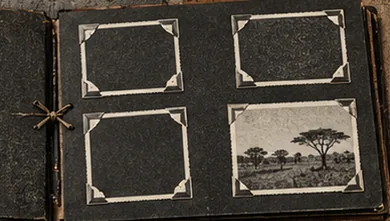 Illustration1963The RCMP takes his Kenya album off display.
- 1967 – 1974High Commissioner to Ceylon, 1967 to 1970. Consul General in Chicago, about 1971 to 1974.
 IllustrationWhat was never askedEvery record found treats the Kenya years as a qualification. No Canadian inquiry, file review or public statement about what the Nairobi CID did under him appears in any of them.
Exhibit · the man they hanged
 Illustration21 October 1956Dedan Kimathi, Field Marshal of the Kenya Land and Freedom Army, is shot and captured at Karunaini, near Nyeri.
- 18 February 1957 · Kamiti PrisonThe colony hangs him and buries him inside the prison walls.
- SinceHis widow, Mukami Kimathi, spent the rest of her life asking for his body. She died on 4 May 2023, still asking. At her funeral the President of Kenya promised to search Kamiti for him. His remains have not been returned.
Winnipeg industrialises it
1959 – 1974 · University of Manitoba- The laboratoryJohn Zubek's isolation lab — the longest-running programme of its kind in the country. The historian Mical Raz puts it more sharply: by the nineteen-seventies he was one of the last researchers anywhere still doing this work. The field had moved on. He had not, which is part of why the fire, when it came, fell on him alone.
- He came from MontrealZubek took his doctorate at Johns Hopkins in 1950 and was an assistant professor of psychology at McGill before going to Manitoba in 1953. The Winnipeg programme is not a parallel line to the Montreal one. It is the same line, continued by a man who had been there.
- FundingDefence Research Board operating grants of $15,000 – $21,000, renewed year after year, alongside US Army money.
- And WashingtonBetween 1964 and 1967 he also took $100,000 from the United States Public Health Service — grant M.H. 08748-01, its own series in the fonds with a second series for the correspondence. Canadian defence money and American federal money in the same filing cabinet.
- And NATOHis surviving correspondence shows he approached many funders; NATO is among the organisations that paid for the work.
- Inside the funderFrom 1958 to 1964 Zubek sat on the Defence Research Board's own Human Resources Scientific Advisory Committee — two terms advising the body that was funding his laboratory.
- ThroughputMore than 500 subjects over fifteen years. Confinements ran up to two weeks.
- Who was insideGraduate students in the biological sciences — and aircrew from RCAF Station Winnipeg. Canadian servicemen, in a Canadian chamber, on a Canadian defence grant.
- The terms$100 for a minimum week inside, with a bonus if the confinement cost you time at work.
- The apparatusA translucent Plexiglas dome under unvarying light and white noise. A wall, a hood and a noise machine, with a consent form.
- What the paperwork called itNot sensory deprivation. The Defence Research Board progress reports, 1964 to 1972, are filed as
Effects of adverse environmental conditions on intellectual and perceptual processes.
The euphemism is not something later writers applied to this work. It is the file name. - March 1974DRB funding ends. Zubek dies by suicide the same year. The laboratory closes and is not reopened.
Exhibit · the subject's own account
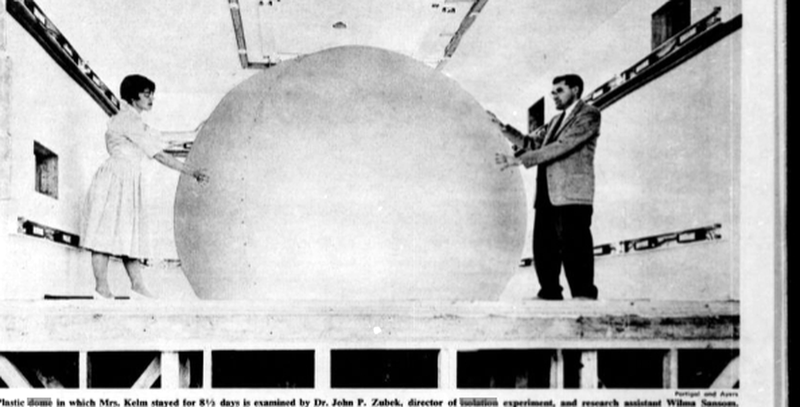
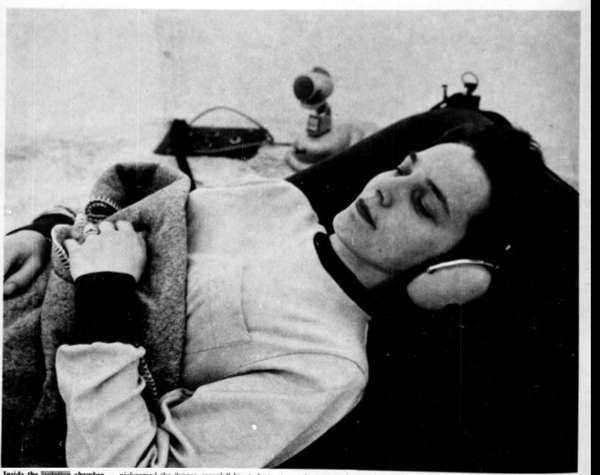
- Eight and a half daysA twenty-five-year-old nurse, married to a psychology graduate student who had been a subject himself, set the women's endurance record. Of twenty-two people selected, only Kelm and Zubek lasted beyond seven days.
- What it was like going in
It was not the shadowy darkness of the closet under the stairs I remembered as a child but a rich, velvety blackness that hugged the eyes — an absolute darkness that sealed me off from the living world.
- Who was paying, said out loud in a national magazineShe names it in passing, the way you name something nobody is hiding: the isolation tests
are sponsored by the Defence Research Board.
- But the subjects were kept quiet
Subjects who have been under observation in an experiment of this kind are instructed not to divulge their experience for fear of influencing those about to be tested.
She only knew what her husband had been through because she was his wife. - What the others reportedMemory loss producing
conditions similar in many respects to those associated with old age
— which is where the student paper got its headline. A man who screamed at two eyeballs looking down at him. A television playing a message he could not read. Dogs howling for hours. And one whobegged to be allowed to return.
- Coming outDays of it afterwards: her mother's soft voice
seemed more like a high-pitched scream
, traffic was deafening, she could not bear her small nephew in the room, and she had hallucinated her husband's death. She had been inside for eight and a half days. - What was planned nextThe editors set out the programme: vibration and heat from below freezing to 106 degrees, two or three people sealed in together, and then weightlessness —
a subject covered in waterproof plastic skin to remain totally submerged in a tank of warm water.
Exhibit · the programme describing itself, while it ran
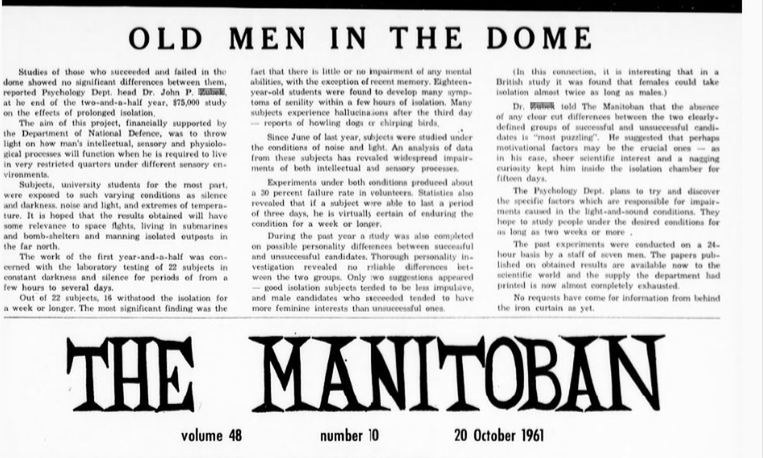
- The money was never hiddenThe students' own paper names the funder in its second paragraph: a two-and-a-half year, $75,000 study,
financially supported by the Department of National Defence.
What changed in 1972 was not the discovery of secret money. It was what the money turned out to be for. - The stated purpose, in 1961
It is hoped that the results obtained will have some relevance to space flights, living in submarines and bomb-shelters and manning isolated outposts in the far north.
Interrogation is not on that list. The defence offered sixty-five years later was the defence offered at the time. - The condition that did the damageDarkness and silence produced
little or no impairment of any mental abilities, with the exception of recent memory.
Noise and light producedwidespread impairments of both intellectual and sensory processes.
The damaging variant is the one with a hood and a sound source — which is the variant that reached Northern Ireland. - What it did to the subjects
Eighteen-year-old students were found to develop many symptoms of senility within a few hours of isolation.
Hallucinations from the third day — howling dogs, chirping birds. About a thirty per cent failure rate among volunteers. - He went in himselfZubek told the paper that
sheer scientific interest and a nagging curiosity kept him inside the isolation chamber for fifteen days.
Whatever else is true of him, he did not ask of others what he would not do. - The last line of the article
No requests have come for information from behind the iron curtain as yet.
The papers were public, the print run nearly exhausted, and the only readership anybody thought to worry about was the Soviet one.
Inside the dome · University of Manitoba
Five hundred people, one at a time, for fifteen years.
Two thousand men in a cloud of CS
1947 – 1968 · Suffield Experimental Station, Alberta- 1947 · who owned itControl of the Suffield Experimental Station passed from the Department of Defence to the civilian Defence Research Board. Four years later that same Board wrote contract X-38. Hebb was a grantee in Montreal. Suffield was the Board's own establishment.
- Before CS · the chamberWartime gas training put the trainee into a chamber filled with chlorine or adamsite, a vomiting agent, told him to remove his respirator, and had him re-enter without it.
It was not uncommon for the trainees to be nauseous.
A decontamination drill put a drop of mustard on the forearm. At least 20 sites across the country were equipped for it. - The 1950s · the staffFew tests, and the subjects were likely all Suffield staff. Two of those experiments exposed staff members to the nerve agent sarin.
- The changeoverThe same decade, the training agent changes. Chlorine and adamsite give way to CS.
- Fall 1968 · Exercise VacuumSuffield runs its largest event. Almost 2,000 men on the Suffield range. Its stated aim:
To test, under realistic battle conditions, new defensive doctrine, training agents, clothing and equipment designed as a result of shortcomings brought out in previous trials…
And the agent:Simulants (mainly based on the tear gas CS) were used in the experimental phase.
- What that is, in the countIn the table of human subjects used in chemical trials at Suffield, Exercise Vacuum is a single line: 2,000 subjects, 51 per cent of every post-war subject at the station. The largest human-subject event in the whole post-war programme, and it ran on tear gas.
- Consent existed by thenInformed consent forms came into use at Suffield and at the Chemical Warfare Laboratories after the war. The earliest such document is dated 1966, two years before Vacuum.
- 2004 · the recognitionOttawa approves $50 million to recognise, with a $24,000 payment and a certificate, people who were human subjects in chemical warfare agent experiments in Canada between 1940 and 1975.
- Where the line fallsThe table puts Vacuum's 2,000 men in the column headed non-CWA simulants. Not a chemical warfare agent. Whether the largest group of subjects at Suffield was recognised by the programme built for Suffield's subjects is not answered by any document found.
The same Board, the same years
One board, two kinds of experiment, twenty-three years. The defence scientist who compiled Suffield's own trial records reached this conclusion about them: by failing to keep adequate records, Canada and its institutionsdid not meet their responsibilities towards the veterans.
The track that used patients
1957 – 1964 · Allan Memorial Institute- Distinct from Hebb and ZubekD. Ewen Cameron at the Allan Memorial Institute, McGill — isolation combined with depatterning, drug-induced sleep and psychic driving.
- Funded from both sidesCanadian federal money alongside CIA money, under MKUltra.
- The decisive differenceHebb and Zubek paid volunteers who could leave. Cameron used psychiatric patients who had not consented and could not. The machinery that makes
could not
lawful in Canada is its own subject: No Safeguards. - Who was admittedLana Ponting, 16, in 1958, for repeatedly running away from home. Janine Huard, in her early thirties, for depression after the birth of her fourth child. Velma Orlikow, wife of the Winnipeg Member of Parliament David Orlikow, for depression after childbirth. Jean Steel, 1957. None of them arrived with a condition that accounts for what was done to them.
- What that answersA person who breaks down after years of drinking can have the drinking named as the cause. A sixteen-year-old who kept leaving home cannot. The Allan Memorial's patients came in with ordinary trouble and left depatterned, which removes every explanation except the treatment.
- 1986 · Ottawa's own opinionThe Department of Justice commissions George Cooper, Q.C., to report on Canadian government funding of the Allan Memorial. Three decades later, Justice Canada still cites that 1986 inquiry for the position that Canada bears
no legal liability or moral responsibility.
- 2 October 1988 · the American settlementNine Canadian plaintiffs settle with the CIA for about US$750,000 among them. No admission of guilt.
- 2017 · one hundred thousand dollars, quietlyAlison Steel, Jean Steel's daughter, receives $100,000 from the federal government out of court, and drops the action she filed in 2015. Velma Orlikow died in 1990, which leaves her family outside the compensation entirely.
- February 2024 · the United States leavesThe Supreme Court of Canada declines leave, and state immunity puts the American government beyond the reach of the Quebec proceeding. What remains is Canadian: the Attorney General of Canada, the McGill University Health Centre, and McGill.
- 31 July 2025 · authorizedJustice Dominique Poulin of the Quebec Superior Court authorizes the class action. Compensatory damages only — punitive damages are refused because the conduct predates the Quebec Charter. Authorization is not a finding on the merits. There has still been no trial, and the lead plaintiffs are Julie Tanny and Lana Ponting, who was the sixteen-year-old.
Exhibit · the same record, in the language of the city it happened in
Two pieces on Cameron and the Allan Memorial, written and produced in Montreal French. Everything the branch above argues, said by the side it was done to. The rest of this page is in the language of the inquiry that never sat.
La mémoire exige des comptes
Paroles
MKUltra / Psychic
Paroles
The reckoning Canada never held
1972 – present- What the programme was forThe stated purpose was spaceflight. Sputnik had gone up in 1957 and nobody knew what prolonged monotony would do to an astronaut. Zubek's results suggested the problem was survivable.
- What his defenders concedeHis colleague A. W. Pressey, writing to defend him, allows the other question was there from the start:
Was brainwashing ever discussed prior to the actual isolation of volunteers in the dome? Of course it was.
On whether it appeared in the funding applications:Quite possibly he had.
- And that question has a written answerThe Board's own form made it compulsory. Every application in the file, 1964 to 1972, carries a printed section:
State (a) general research objective, (b) aspects to be investigated in the year to which grant applies, setting forth the research plan in some detail, (c) relation to defense interest.
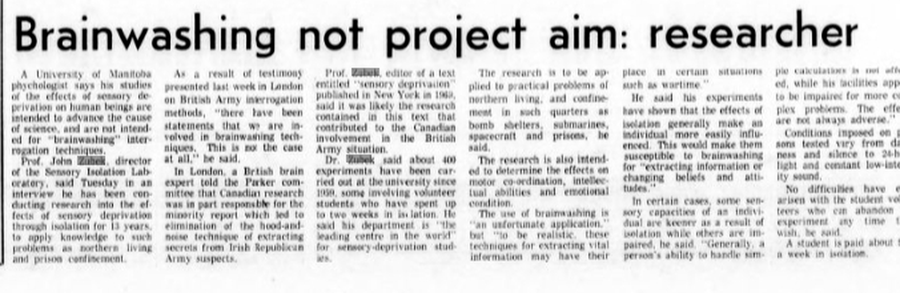
Each one answers it in one to two typed pages. Nine years of written statements about what this had to do with defence, in a folder that is open for consultation. - 1972 · The triggerThe Winnipeg Tribune reports it plainly: in London,
a British brain expert told the Parker committee that Canadian research was in part responsible for the minority report which led to elimination of the hood-and-noise technique of extracting secrets from Irish Republican Army suspects.
Canadian reporters go looking for Zubek. - Where he answeredNot before a committee. In a newspaper.
What bothers me about the cases in Northern Ireland is that these are non-convicted individuals on whom these techniques have been employed.
— John Zubek, Winnipeg Free Press, 1972 - The only body that ever convenedRoughly one hundred students, in a room, in November 1972. His own press file dates the weeks around it: a Manitoban item on 16 November, a hand-drawn poster for 22 November, then Forum and Letters to the Editor together on 30 November 1972. It argued itself out in a student paper and stopped.
- Outside the faculty, thoughOn 21 August 1972 — five months after Parker, three months before the students met — a bereaved Winnipeg family published the usual instruction in the Tribune: in lieu of flowers, contributions to the Manitoba Mental Health and Research Foundation,
care of Dr. John Zubek, Department of Psychology, University of Manitoba.
He held the fund. In the middle of it all, a family who had just buried a child still put his name in the newspaper as the person to send the money to. - Who stood with himNobody.
No one of stature either in the administration or in any Faculty came to his defense.
He believed his telephone was being tapped. He resigned from the Canadian Psychological Association board in April 1974, disappeared on 17 August, and was found three days later; the coroner recorded suicide. - What never happenedNo royal commission. No parliamentary inquiry. No Defence Research Board accounting. No finding of fact by any Canadian tribunal about what was funded, what was learned, or where it went.
- The asymmetryThe subjects were compensated in dollars and the research was published in journals. The programme itself was never examined by anyone with the power to compel an answer. And none of it was secret. The funder was named in the student paper in 1961, the dome was item one in the calendar in 1971, and the purpose was conceded to a reporter in 1972. The missing inquiry is not explained by concealment. Canadians did look — students in a room, somebody with a marker and a sheet of paper, an Irish-Canadian civil rights association in Winnipeg, a reader still arguing it in the Free Press in October 1973. Not one of them could compel a single answer. Every body that could, declined to ask.
Exhibit · six days after Parker, he answers
- Which direction the science travelledNot the one the headline of this page might suggest. The Canadian work is credited with helping to end the technique — it fed the minority report, Gardiner's, the one the British government adopted. That is the honest shape of it and it belongs here.
- He names the vector himselfZubek points at his own edited volume, Sensory Deprivation, published in New York in 1969: it was
likely the research contained in this text that contributed to the Canadian involvement in the British Army situation.
No leak, no transfer, no secret channel. A textbook. - The denial
There have been statements that we are involved in brainwashing techniques. This is not the case at all.
By then about 400 experiments had been run since 1959, and he called his departmentthe leading centre in the world
for sensory-deprivation studies. - The list of applications, 1972
…northern living, and confinement in such quarters as bomb shelters, submarines, spacecraft and prisons.
Prisons had joined the list since 1961. - And then the sentence that undoes the headlineBrainwashing is
an unfortunate application
— butto be realistic, these techniques for extracting vital information may have their place in certain situations such as wartime.
- He describes the mechanism exactlyIsolation, he said, makes a person
more easily influenced
, and so susceptible to brainwashing forextracting information or changing beliefs and attitudes.
Twenty-one years earlier the Defence Research Board had titled Hebb's contract Experimental Studies in Change of Attitude. The phrase had not moved.
Exhibit · the university's own calendar, the year it broke
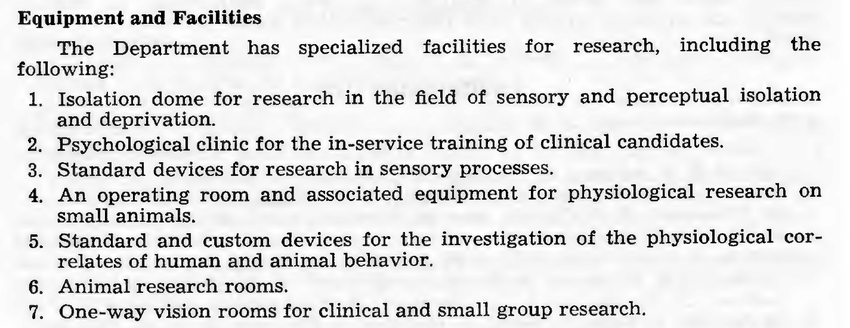
- Item one of seven
Isolation dome for research in the field of sensory and perceptual isolation and deprivation.
Listed ahead of the psychological clinic, ahead of the animal rooms. The same page namessensory and perceptual deprivation
among the department's current research interests. - Who was in the buildingThe same calendar lists J. P. Zubek as Research Professor — no longer head of department, which by 1971 was A. H. Shephard — and A. W. Pressey, who would write the memoir defending him, as an associate professor down the corridor.
- What this settlesThis calendar was in students' hands through the academic year that ran from Parker in March to the protest meeting in November. Anyone who wanted to know what the department did could read it on page 866.
- And three years later, unchangedThe 1974–75 calendar carries the same sentence, word for word:
Isolation dome for research in the field of sensory and perceptual isolation and deprivation.
Still item one. Still ahead of the clinic. Sensory and perceptual deprivation still named among the department's research interests. Parker had reported, the Tribune had run the interview, the students had held their meeting — and the university did not revise a syllable of how it described itself.
Exhibit · the file he kept on himself
- What it isBox 5, File 2 — Newspaper Articles, 1959–74. One folder in his own papers, holding what was being printed about him. Described item by item by the University of Manitoba Archives on request, October 2026.
- He was clipping within two daysThe Tribune interview ran on 8 March 1972. The first item from the controversy in his folder is from The Manitoban, 10 March 1972, headed
U. of M. Psych. Dept.
- Somebody drew a posterThere is no advertisement in the folder. There is a single-page hand-drawn poster:
Organize to End War Research on this Campus.
Dated November 22, with no year written on it. - And Canadians made the linkage themselvesA single sheet, undated, carrying no publication name anywhere on it, titled
A Practical Application of Prof. Zubek's Research.
A handwritten note records who put it out: the Irish Canadian Civil Rights Association, Winnipeg, Manitoba. An Irish-Canadian civil rights organisation in his own city circulated a page under that title, and he kept a copy of it. - Still running a year and a half later
Torture in Ulster
Not a news report. A reader's letter, in the Winnipeg Free Press of 13 October 1973. Parker had reported nineteen months earlier. In the interval no Canadian body had convened, and the argument was being carried in a letters column. - What he wrote for himselfOne page of handwritten notes. No date, no heading, no title; the archives' reading is that they look like notes for an interview. It is the closest thing in sixteen boxes to a statement he prepared, and he was never asked to give it anywhere that could act on it.
Canada bans it on someone else's authority
Current doctrine- The prohibition is realNational Defence's The Law of Interrogation forbids stress positions; sensory deprivation or manipulation by blindfolds, hoods, earmuffs, loud music or bright lights; and sleep deprivation or manipulation — applied as a minimum standard to every detainee.
- The authority is borrowedThe manual grounds that prohibition by quoting a foreign judgment and reciting a foreign case's facts.
- Why it has toThere is no Canadian ruling to cite. There is no Canadian ruling because there was no Canadian inquiry. There was no Canadian inquiry because nobody was ever made to hold one.
- The shape of itCanada funded the experiments that established what the method does to a person, and then prohibited the method by pointing at a court in another country that had to work it out for itself.
What National Defence now prohibits
Each of these was Canadian equipment before it was a Canadian prohibition.
Banned in war, fired into a neighbourhood
1915 – 2012 · Ypres, Ottawa, Quebec City, Toronto- 22 – 24 April 1915 · YpresWhy irritants are forbidden in war. Germany releases 160 tons of chlorine on the 22nd and attacks again in the same pattern on the 24th. Veterans Affairs Canada records 6,035 Canadian casualties in those 48 hours, more than 2,000 of them dead. Gas warfare began with irritants and climbed. The ban exists so that no one starts the climb.
- 1995 · the statuteCanada's Chemical Weapons Convention Implementation Act, section 7:
No person shall use a riot control agent as a method of warfare.
Section 11 asks one thing of anyone who holds a riot control agent for riot control purposes: report it, and keep the documents. - The agent is the one from SuffieldThe powder released over 2,000 men on the Suffield range in 1968 is the powder fired into a Canadian city thirty-three years later.
- For everyone elseA device that discharges tear gas is a prohibited weapon under the federal firearms regulations. Section 117.08 of the Criminal Code exempts people acting for a police force or the Canadian Forces.
- What it isCS, which Ontario's G20 review defines as tear gas, 2-chlorobenzalmalononitrile. Quebec's public health institute: it is not a gas. It is a white crystalline powder carried as smoke, several times heavier than air, so it stays near the ground. It acts in 10 to 30 seconds and lasts 15 to 30 minutes.
- The fourth hypothesisThe institute lists four explanations for how CS harms the body. The fourth is cyanide: CS breaks down into malononitrile and 2-chlorobenzaldehyde, and that breakdown generates cyanide.
- 20 – 22 April 2001 · Quebec CityThe Summit of the Americas. By the police's own count, 5,148 tear gas grenades in 26 hours of operations, two thirds of them on the Saturday. Residents of Saint-Jean-Baptiste, and parts of Montcalm and Saint-Roch, took heavy concentrations for long periods; several had to leave their homes. On Saturday evening the whole of Saint-Jean-Baptiste was gassed. The Ligue des droits et libertés found that police gave residents no clear warning, before the summit or during it.
- 13 November 2003 · the RCMP's watchdogAn interim report from Shirley Heafey, chair of the Commission for Public Complaints Against the RCMP, on a complaint from MP Svend Robinson, who was hit by the gas:
RCMP members used excessive and unjustified force in releasing tear gas to move the protesters when a more measured response could have been attempted first.
- 26 June 2010 · TorontoThe G20. Police use tear gas in the city for the first time. Ontario's independent review: the command centre's notes record muzzle blasts or tear gas in the Queen's Park area at 4:42, 5:04 and 6:05 pm, and
contain no reference to any warnings to the public about the imminent use of tear gas.
- Spring 2012 · QuebecCS is used again to disperse student demonstrations.
One agent, two rules
The escalation argument holds for an army, which can answer in kind. A street cannot. Canada wrote into its own statute that this agent may not be used against an enemy army, and Saint-Jean-Baptiste got 5,148 grenades and no clear warning.
What the nucleus does not depend on
Nothing above requires the overseas campaign, the peninsula, the tribesmen, the leaked files or the foreign inquiry. Strip all of it out and the Canadian account still closes:
- Canada convened the meeting.
- Canada wrote the contracts.
- Canada supplied the chambers, the money and the subjects.
- Canada published the results and shipped them abroad.
- Canada asked itself nothing.
Where a Canadian document could still answer
- John Zubek fonds — University of Manitoba Archives, MSS 85, five metres of records in sixteen boxes. Those boxes
were discovered beneath the sensory deprivation chamber in the Psychology Department
, and they exist because A. W. Pressey — the colleague who later wrote the defence of him — told the archivists they were worth keeping. The Defence Research Board grant is No. 9425-08. - Box 6, File 10 — D.R.B. Research Applications, 1964–72, Grant No. 9425-08. Open. Nine years of applications. Each one answers a printed demand on the Board's own form:
relation to defense interest
One to two typed pages, every year. This is the folder that settles what the money was asked for, and it has been open for consultation in Winnipeg the whole time. - Box 5, File 2 — Newspaper Articles, 1959–74. Open. The press file: the clippings, the hand-drawn poster, the Irish Canadian Civil Rights Association sheet, the 1973 Free Press letter, and his own page of notes.
- Box 6, File 9 — Minutes to D.R.B. Committee, 1963–64: minutes of committee on human engineering, Chairman's Report. One of only three files in the whole fonds marked restricted. The archives give the basis: the nature of the contents, with no time limit set. And because the fonds is a private collection, they have less ability to re-review the file and open it. Sixty years on, the minutes of the committee Zubek sat on are closed, and nothing in the terms of the restriction will open them.
- Defence Research Board records — Library and Archives Canada, RG24; working files catalogued at drbs 170-80/S6. Where the X-38 contract and the June 1951 meeting papers would sit.
- RCAF Station Winnipeg — how aircrew were selected, briefed and released.
- John Timmerman — what Ottawa knew when it hired him. External Affairs personnel and security files, Library and Archives Canada RG 25; RCMP service records, RG 18. The decision of December 1955 to make the Nairobi police commander head of the Department's security programme, and every clearance and appointment after it: Ceylon, 1967; Chicago, 1971. Reachable by access-to-information request.
- The Kenya album — RCMP Historical Collections Unit, Regina. Photographs Timmerman gave the Force in August 1954, through Assistant Commissioner S. Bullard, and withdrew from display in 1963. The accession record says it was withdrawn. It does not say why.
- The Ottawa Citizen, 26 July 1954 — Bernard Dufresne,
Fights Mau Mau: Terror Shadows His Kenya Beat.
The interview he gave his own country, on microfilm. - The Summit tear gas, final word — the RCMP complaints commission's 2003 finding was an interim report. Whether a final report followed, and whether the RCMP accepted it, does not appear in the commission's 2004–05 annual report.
- Section 11 declarations — what each police service has reported holding as a riot control agent under the Chemical Weapons Convention Implementation Act.
- Exercise Vacuum — Department of National Defence,
EX VACUUM Visitors Brochure,
DRDC Suffield Record #2003-4266 (1968), and Laforce, Faust & Guertin, Finding Aids: Field and Laboratory Trials at Suffield and Ottawa, 1941–1975, Volumes 1A–1G and 2A–2H (Defence R&D Canada Suffield, 2006). The brochure names what the 2,000 men were shown and told. Neither is online; the DRDC report library refuses connections. Reachable by access-to-information request. - The recognition line — the eligibility criteria of the Chemical Warfare Agent Testing Recognition Program, 2004. Whether a subject exposed to a simulant, rather than to a chemical warfare agent, qualified. The programme's own site is gone from its address.
- The Cooper opinion itself — Department of Justice Canada, May 1986. The catalogue record is public and the PDF is listed at 36 MB, but the file will not serve to an automated request. The figures for the federal grants to Cameron, and Cooper's own words about what officials knew, are quoted on this page only where another source carries them. The document is the one that would settle both.
- The Quebec class action — authorized 31 July 2025, no trial yet. The only live proceeding in which a Canadian court is still being asked about any of this.
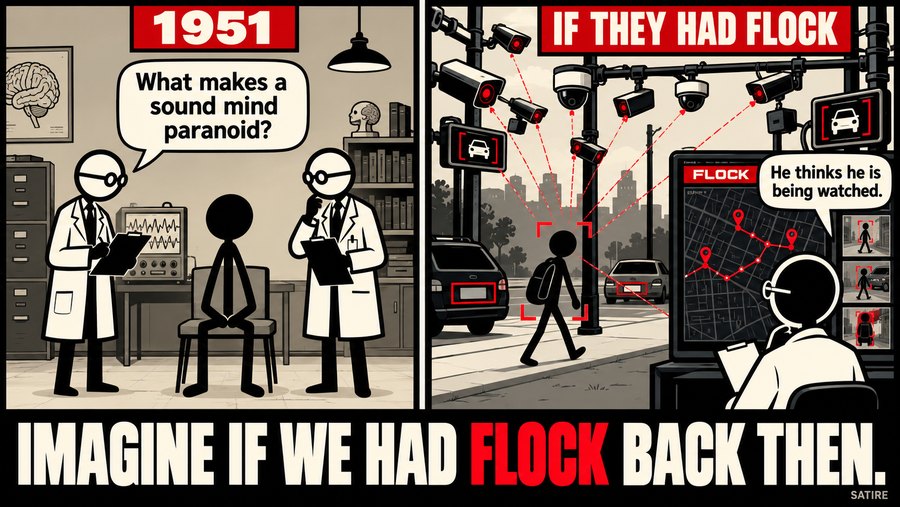
The eyes are real now
1961 – 2026 · Winnipeg, Victoria, Brampton, Sudbury, Ottawa- 1961 · WinnipegInside Zubek's dome, a subject screamed at two eyeballs looking down at him. The watching was a hallucination, produced in a chamber paid for by a defence grant.
- 2012 · VictoriaBritish Columbia's privacy commissioner investigates police licence plate readers and finds parts of the Victoria program unauthorized under provincial law.
Collecting personal information for law enforcement purposes does not extend to retaining information on the suspicionless activities of citizens just in case it may be useful in the future.
- 2025 · BramptonThe city picks Genetec, headquartered in Montreal, the city where X-38 began, for 200 plate-recognition cameras at major intersections, with the data shared with police. Peel Regional Police already read plates at 50 Brampton intersections on Genetec cameras.
- 2025 · SudburyReaders at 16 fixed intersections, on a provincial grant. Plates that match nothing are kept seven days.
- 2026 · OttawaPlate readers go from five patrol vehicles to sixty-five.
- The company in the jokeFlock Safety says it has no partnerships with any Canadian municipality, police service or airport. Canada doesn't need it. The cameras come from a Montreal company.
In 1961 the eyes over the subject were a symptom Canada paid to produce. In 2026 they are a line in a police budget.
Circulate
Seventeen cards. One fact each, with its source on the site. Nothing posts for you.
Sources
- Cecil Rosner, “Isolation,” Canada's History — Hebb, DRB grant X-38, the 1951 Montreal meeting, Zubek's lab, and Lord Gardiner's reference to Canadian research. canadashistory.ca
- “Canada Created a Cold War Isolation Laboratory. It Ended in Scandal,” The Walrus — chamber dimensions, subject demographics, payment terms, the 1972 testimony and student meeting. thewalrus.ca
- A. W. Pressey, "John Zubek: Mentor, friend, victim" (2012) — first-hand memoir by a departmental colleague who was himself a subject. awpressey.com
- Winnifred Kelm, “My Nightmare ‘Ride’ in a Space Capsule,” Weekend Magazine vol. 11 no. 2, 1961 — first-person account by a subject, with the editors' note on the programme and its planned extensions.
- University of Manitoba Course Calendars 1971–72 (p. 866) and 1974–75 — Psychology department equipment, facilities and faculty listings; the facilities entry is identical in both.
- “Brainwashing not project aim: researcher,” Winnipeg Tribune, 8 March 1972 — Zubek interviewed days after the Parker report, University of Manitoba Libraries digital collections.
- “Old Men in the Dome,” The Manitoban, vol. 48 no. 10, 20 October 1961 — contemporaneous report of the programme, University of Manitoba Libraries digital collections.
- Mical Raz, “Alone Again: John Zubek and the Troubled History of Sensory Deprivation Research,” Journal of the History of the Behavioral Sciences (August 2013), doi:10.1002/jhbs.21631 — the scholarly treatment. Its abstract notes the field was
supported by the intelligence community
and that Zubek was among the last still working in it. Paywalled. - W. H. Bexton, W. Heron & T. H. Scott, “Effects of decreased variation in the sensory environment,” Canadian Journal of Psychology 8 (1954).
- Department of National Defence, The Law of Interrogation — prohibited methods. canada.ca
- “Interrogation, sensory deprivation and the CIA: A Canadian connection,” J-Source. j-source.ca
- John Zubek fonds, University of Manitoba Archives & Special Collections, MSS 85 — finding aid, plus item-level description of Box 5 File 2 and Box 6 Files 9 and 10 supplied by the Archives on request, 8 October 2026. Issues of The Manitoban and the Winnipeg Tribune are digitised and keyword-searchable at digitalcollections.lib.umanitoba.ca.
- H. Osmond & J. Smythies, “Schizophrenia: a new approach,” Journal of Mental Science, April 1952 — the M-substance hypothesis. cambridge.org
- A. Hoffer, H. Osmond & J. Smythies, “Schizophrenia: a new approach. II. Result of a year's research,” Journal of Mental Science 100 (1954): 29–45 — adrenochrome. doi:10.1192/bjp.100.418.29
- John A. Mills, “Lessons from the periphery: psychiatry in Saskatchewan, Canada, 1944–68,” History of Psychiatry (2007) — the Weyburn funding, Rockefeller, provincial and federal. doi:10.1177/0957154x06073011
- Erika Dyck, Psychedelic Psychiatry: LSD on the Canadian Prairies (University of Manitoba Press) — the Saskatchewan programme. uofmpress.ca
- Aldous Huxley, The Doors of Perception (1954) — mescaline supplied by Osmond, May 1953; adrenochrome named in the text.
- Erika Dyck, “‘Hitting Highs at Rock Bottom’: LSD Treatment for Alcoholism, 1950–1970,” Social History of Medicine 19:2 (2006) — self-experimentation before patients; the 216 Saskatoon case files, 1958–66, each with a consent form. doi:10.1093/shm/hkl039
- Erika Dyck, “Flashback: psychiatric experimentation with LSD in historical perspective,” Canadian Journal of Psychiatry 50:7 (2005) — hospital records and interviews with former subjects. doi:10.1177/070674370505000703
- Office of the Information and Privacy Commissioner for British Columbia, Investigation Report F12-04: Use of Automated Licence Plate Recognition Technology by the Victoria Police Department, 15 November 2012. oipc.bc.ca
- Genetec, “City of Brampton selects Genetec solutions to enhance public safety and combat vehicle theft,” March 2025. genetec.com
- Greater Sudbury Police Service, “Stationary Automated Licence Plate Readers,” 27 August 2025. gsps.ca
- “Use of Licence Plate-Reading Cameras Expanding in Canada as Flock-Related Privacy Concerns Grow in US,” The Epoch Times, 14 August 2026 — Ottawa's five-to-sixty-five figure, Peel's 50 Genetec intersections, and Flock's statement on Canadian partnerships. theepochtimes.com
- Kenya Gazette, 6 March 1951, p. 636 — Timmerman appointed Assistant Commissioner of Police from 18 February 1951; Colony and Protectorate of Kenya, Kenya Police Annual Report 1951, p. 1 — assumes control of the CID; Kenya Staff List 1951, p. 37. books.google.com
- London Gazette, supplement 40188, 10 June 1954, p. 3293 — Queen's Police Medal for Distinguished Service. thegazette.co.uk Supplement 41034, 29 March 1957, p. 1951 — mentioned for distinguished services in Kenya, April 1954 to October 1955. thegazette.co.uk
- Illustrated London News, 1953, p. 76; Time and Tide, 1953, p. 1299; East Africa and Rhodesia, 1953, p. 132, and 1954, p. 1097 — Operation Anvil. books.google.com
- Dudley Thompson, From Kingston to Kenya (1993), pp. 86–87 — Timmerman and Heine. books.google.com
- Bethwell Allan Ogot, “Mau Mau and the Fourth Estate, 1952–1956,” in Building on the Indigenous: Selected Essays 1981–1998 (Kisumu: Anyange Press, 1999), p. 43; reprinted in The Challenges of History and Leadership in Africa (2002), p. 134.
- Who's Who of Southern Africa (1979), p. 297 — Gerald Heine, Superintendent, CID Nairobi; South African Police, 1963–65.
- Caroline Elkins, Imperial Reckoning: The Untold Story of Britain's Gulag in Kenya (New York: Henry Holt, 2005) — the CID, the interrogation methods, the Kenya Regiment testimony.
- David Anderson, Histories of the Hanged: The Dirty War in Kenya and the End of Empire (London: Weidenfeld & Nicolson, 2005) — the hangings and the official count.
- John Blacker, “The demography of Mau Mau: fertility and mortality in Kenya in the 1950s: a demographer's viewpoint,” African Affairs 106:423 (2007): 205–227. lshtm.ac.uk
- House of Commons (UK), Hola detention camp debate, 16 June 1959 — Barbara Castle reads MacPherson's letters. api.parliament.uk House of Lords, “Resignation of Colonel Young,” 22 December 1954. api.parliament.uk
- Mutua & Ors v Foreign and Commonwealth Office [2011] EWHC 1913 (QB) and [2012] EWHC 2678 (QB); Foreign Secretary's statement on the settlement, House of Commons, 6 June 2013.
- Senate of Canada, Debates, 20 January 1955, pp. 58–62 — Senator F. W. Gershaw. parl.canadiana.ca
- House of Commons (Canada), Debates, 7 February 1956, p. 942 — Lester Pearson. parl.canadiana.ca Full-text search of the Debates, 1952–1960, for Hola: no result.
- John Hilliker & Donald Barry, Canada's Department of External Affairs, vol. 2 (1995), p. 102 — Timmerman chosen to head the security programme. books.google.com External Affairs bulletin, January–February 1956, p. 35 — appointed effective 16 December 1955.
- John Starnes, Closely Guarded: A Life in Canadian Security and Intelligence (University of Toronto Press, 1998), pp. 34, 94.
- Keith Bell, “Picturing Control,” in War and Remembrance (2022), pp. 166–174 — RCMP service, the Kenya album and its withdrawal in 1963, the Ottawa Journal of 24 July and Ottawa Citizen of 26 July 1954. books.google.com
- External Affairs, 1967 and 1970 — High Commissioner to Ceylon; Industrial Canada, 1971, p. 51, and Canada Weekly, 1974, p. 11 — Consul General in Chicago; Front Page Challenge twenty-fifth anniversary book (1981), p. 125.
- Report of the Committee of Privy Counsellors (Parker), Cmnd 4901, March 1972, §10. ojp.gov
- On Kimathi's remains: People Daily, May 2023; Citizen Digital, 13 May 2023. citizen.digital
- Yves Engler, “British atrocities in colonial Kenya: the Canadian connection,” Pambazuka News, 2015 — the lead that brought this branch in. pambazuka.org
- Chemical Weapons Convention Implementation Act, S.C. 1995, c. 25, ss. 7 and 11. laws-lois.justice.gc.ca Regulations Prescribing Certain Firearms and Other Weapons…, SOR/98-462, Part 3, item 1. laws-lois.justice.gc.ca Criminal Code, s. 117.08. laws-lois.justice.gc.ca
- L. Londéi-Leduc & A. Larocque, “Les agents de contrôle de foule,” Bulletin d'information toxicologique 30:1 (2014): 2–13, Institut national de santé publique du Québec — CS a crystalline powder, onset and duration, the cyanide hypothesis, 2001 and 2012. inspq.qc.ca
- Ligue des droits et libertés, Comité de surveillance des libertés civiles, Violations des droits et libertés au Sommet des Amériques, Québec avril 2001, 14 June 2001 — the 5,148 grenades, the neighbourhoods, the absence of warning. liguedesdroits.ca
- “RCMP used ‘excessive force’ at Quebec summit: report,” CBC News, 13 November 2003 — the Commission for Public Complaints Against the RCMP interim report. cbc.ca
- Office of the Independent Police Review Director, Policing the Right to Protest: G20 Systemic Review Report, May 2012. leca.ca “G20 protest violence prompts over 400 arrests,” CBC News, 26 June 2010. cbc.ca
- Clément Laforce, The Use of Human Subjects in Chemical Warfare Agent Experiments: An Ethical Perspective, Canadian Forces College, National Security Studies Course 8, May 2006 — Exercise Vacuum and the CS simulants, Table 1 and the 2,000 subjects, the 1947 transfer to the Defence Research Board, the wartime gas chambers, the sarin tests, the 1966 consent form, and the conclusion on Canada's responsibilities. cfc.forces.gc.ca, archived
- Veterans Affairs Canada, “2nd Battle of Ypres” — 160 tons of chlorine, 22 April 1915, and 6,035 Canadian casualties in 48 hours. veterans.gc.ca
- André Marin, DND/CF Ombudsman, Complaints Concerning Chemical Agent Testing During World War II — Report, 2004 — the wartime testing and the recognition programme. It does not mention tear gas, CS or riot control agents. canada.ca
- George Cooper, Q.C., Opinion of George Cooper, Q.C. regarding Canadian government funding of the Allan Memorial Institute in the 1950's and 1960's, Department of Justice Canada, May 1986, catalogue J2-63/1986E-PDF — the opinion Justice Canada still cites. publications.gc.ca
- “Federal government quietly compensates daughter of brainwashing experiments victim,” CBC News, 1 November 2017 — Jean Steel's 1957 admission, Alison Steel's $100,000 settlement, the federal grants, and Justice Canada's position. cbc.ca “‘She went away, hoping to get better’,” CBC News, November 2017 — Velma Orlikow. cbc.ca
- “Survivors of MK-ULTRA brainwashing experiments want judge to approve class action lawsuit,” CTV News Montreal — Lana Ponting's testimony in Quebec Superior Court. ctvnews.ca “MK-ULTRA mind control class action authorized by Quebec Superior Court,” CTV News, 31 July 2025. ctvnews.ca
- Memorable Manitobans: Velma Jessie “Val” Orlikow (1917–1990), Manitoba Historical Society — the Montreal treatments and the 1984 suit. mhs.mb.ca The action is filed as Mrs. David Orlikow v. United States Government; University of Toronto Archives. library.utoronto.ca